Machine Learning Startup Project
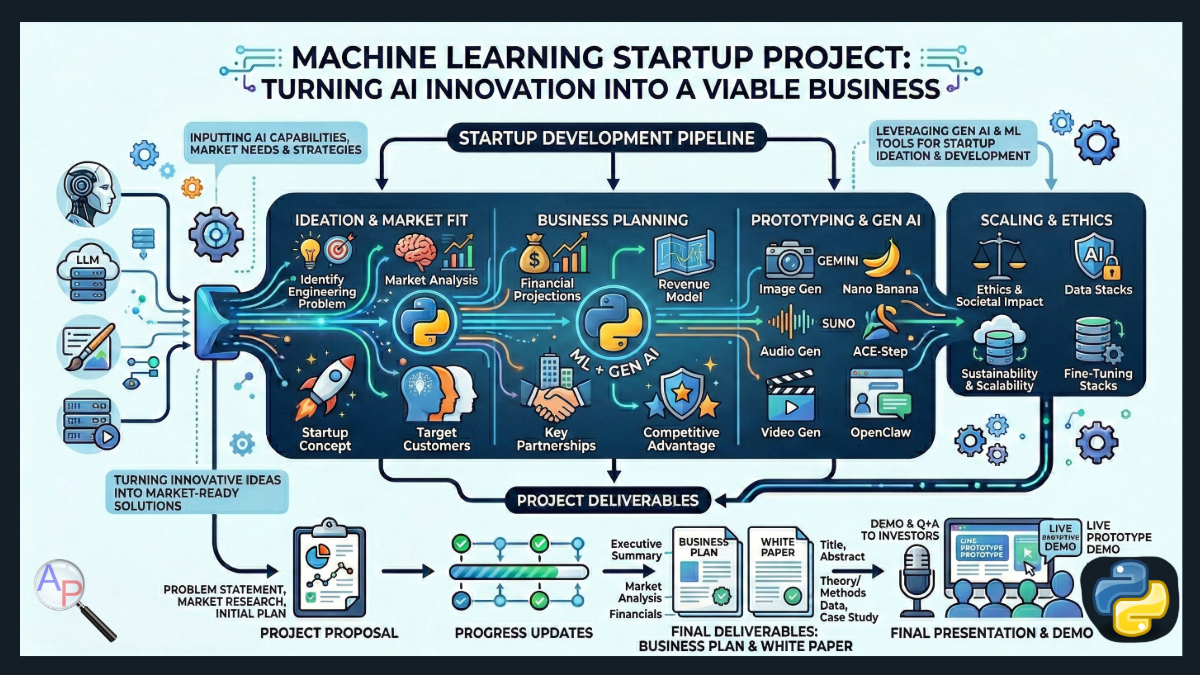
The Machine Learning Startup Project is a project alternative where students use machine learning and generative AI to create a complete engineering solution. Students may work individually or in teams of up to 3 members. The objective is to explore how modern AI tools can be used to ideate, build, and communicate a new product or service and the business around it.
Objectives
- Identify a real‑world engineering problem that can be addressed through machine learning and generative AI. Develop a business plan that outlines the problem, market need, solution concept, target customers, competitive advantages, revenue model, funding requirements, and financial projections.
- Design and implement a service or product prototype that leverages machine learning techniques (classification, regression, clustering, etc.) and generative AI for content creation.
- Create a professional website or landing page for your startup that clearly communicates the value proposition and demonstrates the prototype.
- Write a technical white paper that describes the problem context, literature review, theoretical approach, method and algorithms (including equations), data sources, case study or proof‑of‑concept results, and conclusions.
- Develop marketing and communication assets (images, videos, audio clips) using generative AI tools.
- Present the project with a live demonstration and Q&A to potential investors or customers.
Productivity Multiplier
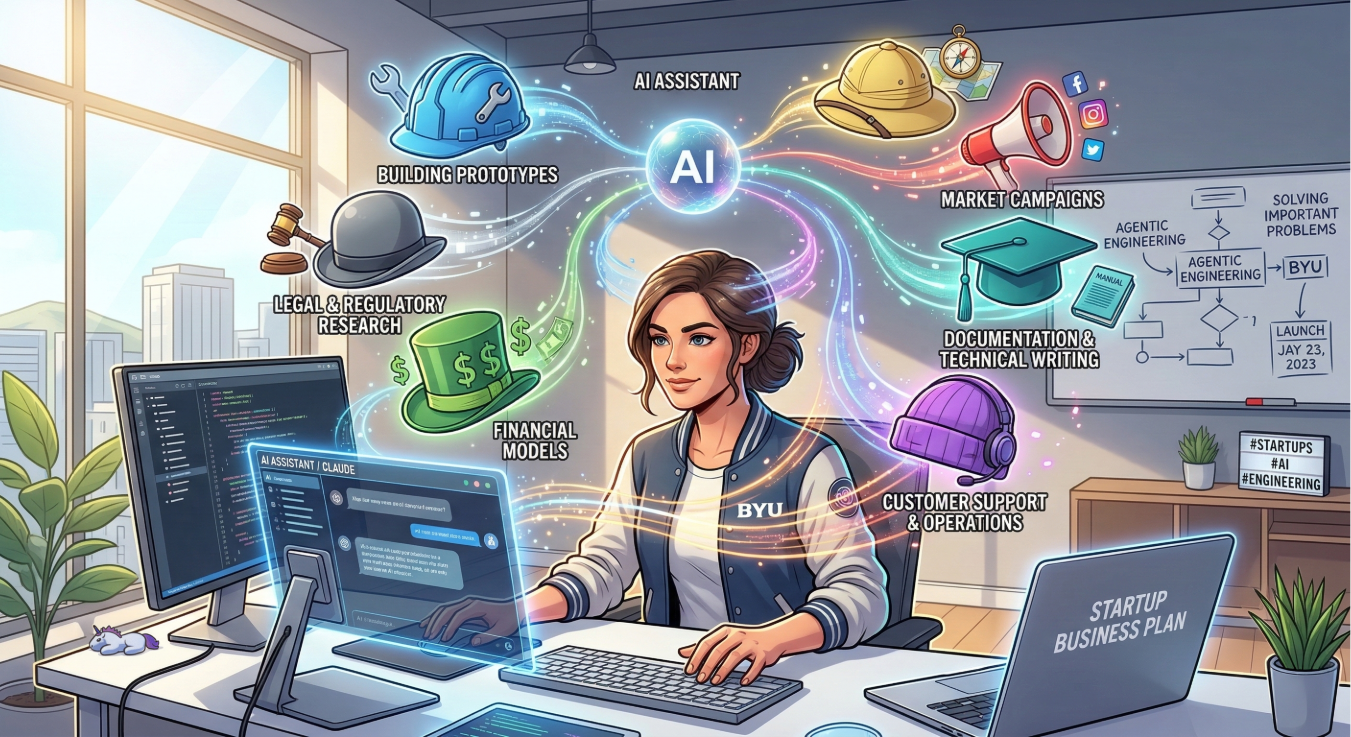
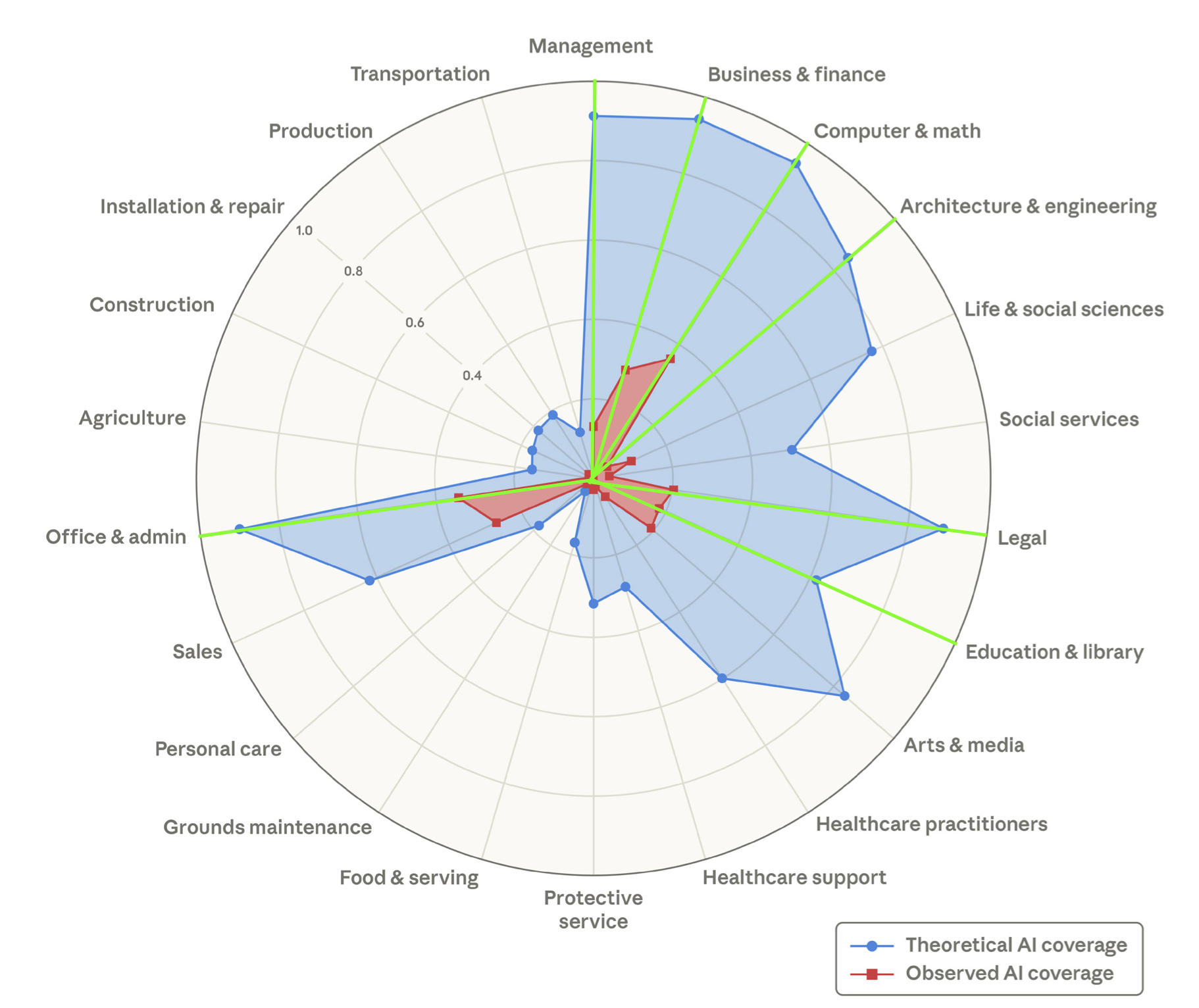
Modern generative AI tools are lowering the barrier for engineers to launch new startups. Traditionally, starting a company required assembling expertise in many areas beyond engineering, including legal structure, business planning, software development, marketing, and customer support. Today, AI systems can assist with many of these supporting roles by helping draft contracts, generate business plans, build software prototypes, create marketing materials, and automate documentation. This allows engineers to focus on what remains most valuable: identifying important problems, applying engineering judgment, and developing innovative technical solutions. A report from Anthropic on real-world AI usage suggests that AI is currently acting more as a productivity multiplier than a replacement for skilled professionals. Engineers who learn to use AI effectively can move faster from idea to prototype to business launch, coordinating AI tools to support the many responsibilities involved in building a new company.
Recommended Tools
Business plan and white paper
- OpenAI PRISM – use for conducting literature reviews
- OpenAI PRISM – use for conducting literature reviews and drafting your technical white paper.
Standard spreadsheet and presentation tools for financial projections and business plan documents.
- Google Gemini, OpenAI ChatGPT, xAI Groq, and OpenWebUI (local) for chat interfaces
Content creation
- Nano Banana – Gemini‑based image generation tool for creating custom graphics.
- Suno or ACE‑Step – generative audio tools for creating soundtracks or voice overs.
Video editing or AI‑video generation platforms (e.g. Runway, Pika) can be used to assemble promotional videos.
Customer interaction and prototyping
- OpenClaw – build a customer support chatbot or automated assistant.
- Ollama and vLLM – run large language models locally for privacy‑sensitive tasks or offline demos.
Coding assistance
- Antigravity, Claude Code, Codex, and Cursor – agentic coding tools to accelerate software development for your prototype.
Business Plan Guidelines
A clear business plan is essential. At minimum, include:
- Executive summary – brief description of your company, mission, product/service, and high‑level growth plans.
- Company description – detail the problem you are solving, the customers you intend to serve, and your competitive advantages.
- Market analysis – research the target market and competitors. Identify trends, size of the opportunity, and how your startup will capture market share.
- Organization and management – describe the legal structure (LLC, partnership, corporation) and team roles.
- Service or product line – explain what you offer, the technology stack, lifecycle, and any intellectual property or patents.
- Marketing and sales – outline how you will reach customers, including channels (web, social media, partnerships) and sales process.
- Funding request (optional) – if seeking investment, specify funding requirements, intended uses of funds, and desired terms.
- Financial projections – provide revenue forecasts, cost estimates, and break‑even analysis for at least 3–5 years.
- Appendix – include additional materials such as resumes, diagrams, or legal documents.
A lean startup plan may be used instead of a full business plan. It should succinctly address key partnerships, key activities, key resources, value proposition, customer relationships, customer segments, channels, cost structure, and revenue streams.
Technical White Paper
The white paper should follow a scholarly structure:
- Title, authors, abstract
- Introduction / literature review – summarize prior work and clearly state the problem.
- Theory / methods – describe the machine learning and generative AI methods used, including equations and algorithms.
- Data sources – describe where your training and test data come from and how they were prepared.
- Case study – apply your methods to a real or simulated data set to demonstrate feasibility.
- Results – present training, validation, and test performance, including metrics and model diagnostics.
- Discussion – interpret the results, discuss limitations, and compare with literature.
- Conclusions and future work – summarize the contribution and outline next steps.
- References – cite all sources.
You can use tools such as OpenAI PRISM to help with literature search, summarization, and manuscript drafting. Ensure all citations and references are properly formatted.
Generative AI Assets
As part of your marketing, create high‑quality graphics, videos and audio clips. Consider:
- Using Gemini (Google) Nano Banana for illustrative diagrams, concept art, product mock‑ups or logos.
- Composing background music or narration with Suno or ACE‑Step. Make sure audio matches the tone of your product.
- Producing short demo videos explaining your solution. You may combine screen recordings with AI‑generated narration or animations.
Integrate media assets into your website and presentation.
Additional Considerations
- Identify use cases and evaluate benefit vs. risk – Carefully map your business needs to the capabilities of generative AI. Focus on tasks where AI can enhance workflows or enable new features. Be cautious with high‑stakes or high‑volume decisions, where generative models’ hallucinations and inference costs could be problematic. Consider using human‑in‑the‑loop systems.
- Data privacy and compliance – Inventory the personal data used by your AI systems and document data flows. Update asset registers to include AI solutions. Incorporate privacy by design, encryption, and data governance policies to comply with laws like GDPR or CCPA. Regularly assess and mitigate risks such as bias, model drift, and potential harm to employees or customers. Provide employee training on ethical AI use.
- Intellectual property and ownership – Understand that prompts and outputs from generative AI platforms may not be confidential, and you may not own the generated content. Open‑source training data could introduce license obligations, and outputs may contain errors or biases. Have clear policies on acceptable use and quality control.
- Model selection and cost – Decide whether to build your own model, fine‑tune an open‑source model, or use a proprietary platform. Custom models offer maximum control but require significant data, compute resources, and expertise. Fine‑tuning open‑source models can be cost‑effective and privacy‑preserving. Proprietary models offer convenience but may involve high API costs and potential data security concerns.
- Market fit and customer feedback – Continuously test your prototype with potential users. Collect feedback to refine product features, user experience, and pricing.
- Ethics and societal impact – Consider how your solution may impact stakeholders. Avoid AI‑washing and overstated claims. Plan for workforce training and upskilling, and consider environmental impacts.
- Sustainability and scalability – Evaluate how your startup will scale in terms of infrastructure, human resources, and long‑term sustainability. Consider open‑source tools and local deployment options (e.g. Ollama, vLLM) to reduce ongoing costs.
- Timeline and milestones – Define key milestones such as problem identification, business plan draft, prototype completion, white paper draft, marketing asset creation, and final presentation. Update your project timeline regularly and manage uncertainties proactively.
Deliverables and Evaluation
- Project proposal – Outline your problem statement, market research, business plan outline, initial system diagram (features and labels), data sources, ML tasks (classification/regression/clustering), and timeline.
- Progress report – Provide updates on data collection, cleansing, exploratory analysis, machine learning models tested, hyperparameter tuning, and early prototype results. Include updates to business plan and market analysis.
- Final report – Submit a complete business plan, technical white paper, prototype demonstration (e.g. website or application), marketing assets, and final presentation slides. Reports should include all sections described above and highlight strengths, challenges, and future directions.
- Presentation – Present your startup concept to the class, demonstrating the ML‑powered product or service, summarizing the business plan, and showcasing the generative AI assets. Prepare for questions on technical, business, ethical, and social aspects.
This project encourages creativity and practical application of machine learning and generative AI. By completing it, you will gain experience in both the technical and business dimensions of bringing an engineering innovation to market.