Discrete Variables with a Two Bar Truss Design
We are revisiting the two-bar truss problem but with design variables allowed only at discrete values instead of continuous values. In many engineering design problems, the design variables are not continuous but are possible only at select levels known as “discrete” values. These levels may be binary (e.g. 0 or 1), integer (e.g. 5, 6, 7, 8), or at real number values (e.g. 0.05, 0.10, 0.20, 0.50). Recall that we are interested in designing a truss that has a minimum weight, will not yield, will not buckle, and does not deflect "excessively”.
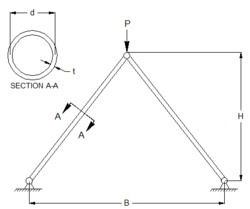
 This assignment can be completed in groups of two. Additional guidelines on individual, collaborative, and group assignments are provided under the Expectations link.
Generative AI Learning
Use these prompts to test your understanding after completing the exercise. Direct the AI - it may test your logic, but run the discrete optimization yourself.
Tip: This lesson scales to modern practice: topology optimization for additive manufacturing turns 'material or void' in each cell into millions of discrete decisions - the reason practical methods relax the problem to continuous densities first is exactly the relaxation idea in this assignment.
What to Turn In
Submit a short report (PDF, 1-2 pages) that curates your results into a demonstration of what you learned. You may use Generative AI to help write the report, but you must guide it to the correct results, justifications, and assumptions. Answer these questions:
- Report the continuous optimum, the nearest-value rounded design (with a feasibility check of every constraint), and the true discrete optimum. Quantify the cost of rounding and the cost of discreteness.
- How many discrete combinations exist for your variable levels? How many did your solution method actually evaluate, and why is that a fair measure of branch and bound's value here?
- Show the branch and bound logic for at least the first branching decision: the relaxation solved, the bound obtained, and what was pruned.
- From the reviewer prompt: what did the AI challenge, and what was your defense?
- From the quiz prompt: one question you missed and the corrected answer.
