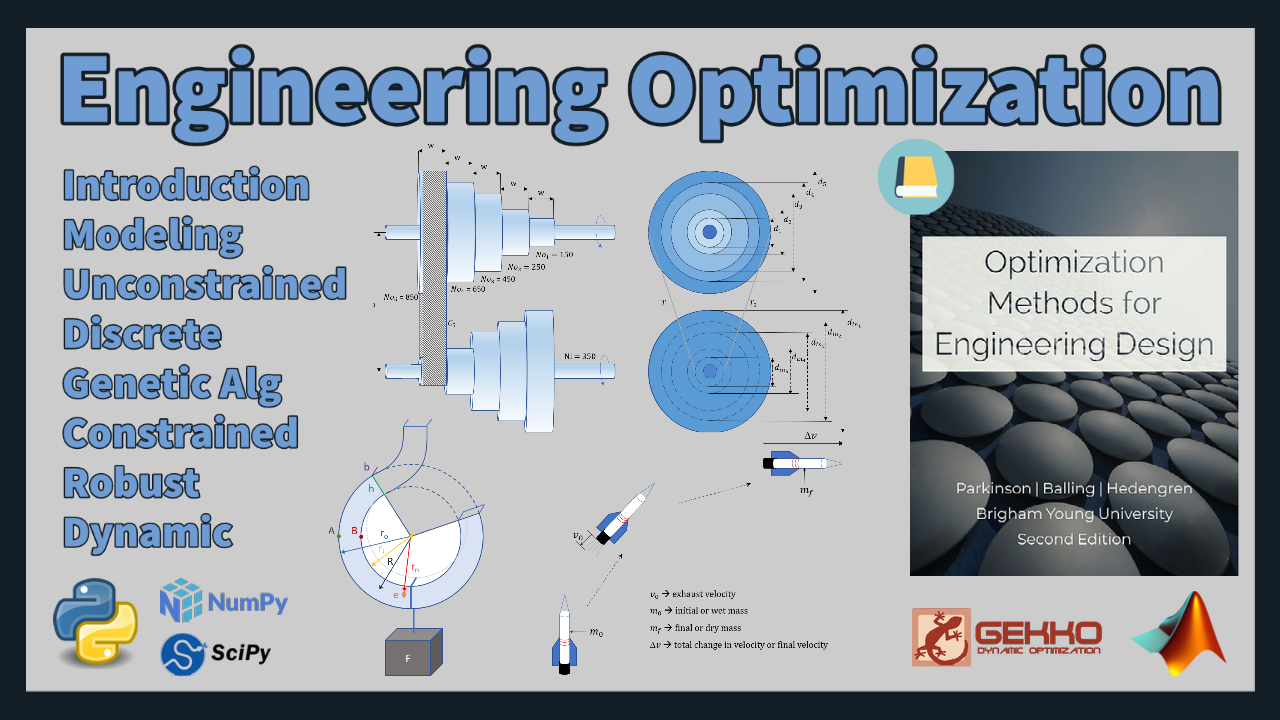
Engineering Optimization
Welcome to Engineering Optimization. This course is designed to provide an introduction to the fundamentals of optimization, with an emphasis on engineering problems.
The course explores a variety of optimization strategies and tools that can be used to solve engineering problems. It covers topics such as linear programming, nonlinear programming, discrete optimization, and metaheuristics. The optimization methods are applied to simplified real-world engineering problems. The course is designed to deliver a strong understanding of the fundamentals of optimization and enable engineers and scientists to apply the methods to electrical, chemical, mechanical, and civil engineering work.
ME575/CE575: Optimization Techniques in Engineering (3 credit hours). This course covers theory and applications for optimization in engineering design. Topics include:
- Optimization Introduction
- Mathematical Modeling
- Unconstrained Optimization
- Discrete Optimization
- Genetic Algorithms
- Constrained Optimization
- Robust Optimization
- Dynamic Optimization
Both MATLAB and Python are used throughout the course as computational tools for implementing homework and exam problems and for the course projects. Tutorials in MATLAB and Python are provided as part of a separate computational tools course.
Professor: John D. Hedengren
 Office: 801-422-2590, 330L EB
 Cell: 801-477-7341
 Contact: john.hedengren [at] byu.edu
| John Hedengren leads the BYU PRISM group with interests in combining data science, optimization, and automation with current projects in hybrid nuclear energy system design and unmanned aerial vehicle photogrammetry. He earned a doctoral degree at the University of Texas at Austin and worked 5 years with ExxonMobil Chemical prior to joining BYU in 2011. |  |
Book
Everyone will have access to the book (download PDFs). You will need to thoroughly understand everything in the chapters. Please read the appropriate section before coming to class as indicated on the schedule.
References
- Belegundu A. and T. Chandrupatla Optimization Concepts and Applications in Engineering, Prentice Hall, 1999.
- Gen, M. and R. Cheng, Genetic Algorithms and Engineering Optimization, Wiley, 2000.
- Edgar, T.F., Himmelblau, D.M., and L.S. Lasdon, Optimization of Chemical Processes, McGraw Hill, 2001. Book | Chapters
- Fletcher R., Practical Methods of Optimization Volumes 1,2, John Wiley 1980, 1981.
- Luenberger and Ye, Linear and Nonlinear Programming Third Edition, Springer, 2008.
- Martins, J, Ning, A., Engineering Design Optimization, Cambridge University Press, 2021. Preprint
- Postek, K., Zocca, A., Gromicho, J., Kantor, J., Data-Driven Mathematical Optimization in Python, 2023.
There is also another engineering optimization course taught by Dr. Andrew Ning of the Mechanical Engineering department. Dr. Ning has another optimization textbook that is very good and focuses on aerospace engineering examples. There are also many online resources such as Mathematical Optimization for Engineers (edX course).